Hartselle Water Quality & Hardness: The Complete Homeowner Chemistry Report
Hartselle municipal tap water averages 12 to 18 Grains Per Gallon (GPG) of mineral hardness in the “Very Hard” category. Sourced from the Tennessee River, our local water carries minerals and disinfectants that impact water heaters, fixtures, and family health.
Where Does Hartselle’s Water Come From?
Understanding your home’s water begins at the municipal source. While compliant with EPA minimums, Hartselle tap water carries heavy mineral density and disinfectant byproducts.
Tennessee River Surface Water
Hartselle Utilities does not pump from local city wells. Instead, it buys treated water from Decatur Utilities, which draws from the Tennessee River at Mallard Fox Creek.
12–18 GPG Limestone Hardness
The Tennessee River basin flows over extensive limestone bedrock. Water dissolves high concentrations of calcium carbonate and magnesium, generating rock-like scale inside residential pipes.
Booster Chlorination Routine
Hartselle Utilities injects secondary free chlorine to maintain biological safety across miles of mains and storage tanks. This causes chlorine odors and dry skin during showers.
Rural Well Water vs. Municipal
Outside city limits in Danville, Falkville, and Eva, private wells encounter dissolved iron (0.1–0.35+ ppm), sulfur odor, and silt. These require dedicated oxidation filtration.
The 7 Flagged Chemical & Mineral Parameters in Hartselle Tap Water
Data comes from the annual Hartselle Utility Board Consumer Confidence Report, Decatur Utilities audits, and independent Morgan County lab samples.
| Parameter | Hartselle Observed Level | EPA Legal Limit (MCL) | Ideal Target | Primary Source | Household & Plumbing Impact |
|---|---|---|---|---|---|
| 1. Mineral Hardness (CaCO₃) | 12 to 18 GPG (205–308 ppm) |
Unregulated (Secondary) | < 1.0 GPG (Soft) | Limestone karst rock formations | Destroys water heaters, clogs showerheads, creates white faucet crust, etches glassware. |
| 2. Free Chlorine Residual | 0.8 to 1.8 ppm | 4.0 ppm (MRDL) | 0.0 ppm at tap | Decatur treatment & Hartselle booster dosing | Bleach odor, dry itchy skin, degrades rubber toilet flappers and faucet seals. |
| 3. Total Trihalomethanes (TTHMs) | 38 to 65 ppb | 80 ppb | 0 ppb | Chlorine reaction with river organic matter | Volatile chemical byproducts associated with long-term liver, kidney, and health risks. |
| 4. Haloacetic Acids (HAA5) | 24 to 48 ppb | 60 ppb | 0 ppb | Disinfection reaction with surface humic acids | Secondary chlorination byproducts creating unpleasant chemical aftertaste in drinking water. |
| 5. Fluoride | 0.6 to 0.8 ppm | 4.0 ppm | 0.7 ppm target | Municipal dental additive + natural minerals | Added by Decatur Utilities. Requires specialized Reverse Osmosis filtration if removal is desired. |
| 6. Dissolved Iron & Manganese | <0.05 ppm (City) 0.10–0.35+ ppm (Wells) |
0.30 ppm (Secondary) | < 0.02 ppm | Southwest Morgan County groundwater aquifers | Rusty orange and black stains on porcelain toilets, bathtubs, sinks, and laundry fabrics. |
| 7. Lead & Copper Corrosion | Lead: 1–4 ppb Copper: 0.2–0.5 ppm |
Lead: 15 ppb (AL) Copper: 1.3 ppm |
0 ppb Lead | Corrosion of pre-1986 household copper solder | Toxic heavy metal leaching from older residential interior plumbing, brass faucets, and galvanized pipes. |
1. Why Hartselle Water Is So Hard (12–18 GPG)
Water hardness is measured in Grains Per Gallon (GPG). One grain equals 17.1 mg/L of dissolved calcium and magnesium. Hartselle tap water tests at 12 to 18 GPG (205–308 mg/L).
The Water Quality Association classifies anything over 10.5 GPG as “Very Hard”. Heated water precipitates solid limestone scale that clogs valves, chokes showerheads, and coats water heater elements.
2. Disinfection Byproducts (TTHMs & HAA5)
Chlorine is essential to prevent waterborne bacteria. However, free chlorine reacts with organic river matter to form Trihalomethanes (TTHMs) and Haloacetic Acids (HAA5).
While municipal readings comply with annual averages, summer spikes approach allowable limits. Whole-home catalytic carbon filters adsorb these chemical byproducts before they enter your home.
The Real Impact on Your Home Appliances & Plumbing
Hard water and unconditioned chemicals silently destroy expensive household plumbing equipment years before its normal service life.
1. Water Heaters (Storage & Tankless)
- 15% to 25% Energy Penalty: A 1/8-inch calcium scale layer insulates electric elements and gas burners, spiking utility bills.
- “Kettle Popping” Sounds: Trapped water boiling beneath the hardened calcium layer creates loud banging or rumbling sounds.
- Premature Tank Failure: Scale cuts tank life from 12–15 years down to 6–8 years. It also clogs tankless exchangers and voids warranties.
2. Dishwashers & Washing Machines
- Cloudy, Etched Glassware: Hard water minerals bond to glass in high heat, creating permanent silica film that no rinse aid can remove.
- 50% Extra Detergent Waste: Calcium inactivates soap molecules, forcing families to use double the detergent to achieve a standard lather.
- Burned Out Heating Coils: Mineral crust covers dishwasher heating loops, causing slow drying cycles and heating element failure.
3. Showerheads, Faucets & Valves
- Clogged Aerators & Spray Holes: White crust chokes tiny nozzle orifices, deflecting spray patterns and cutting perceived shower pressure.
- Scored Cartridges & Dripping Spouts: Abrasive mineral crystals score smooth ceramic faucet discs, triggering persistent leaks.
- Degraded Rubber Seals: Combined chlorine residuals cause toilet flappers and shut-off valve rubber O-rings to dissolve and seep water.
How to Solve Hartselle’s Water Chemistry Challenges
Protect your plumbing investment with proven, code-compliant equipment installed by licensed North Alabama master plumbers.
Water Softener Installation
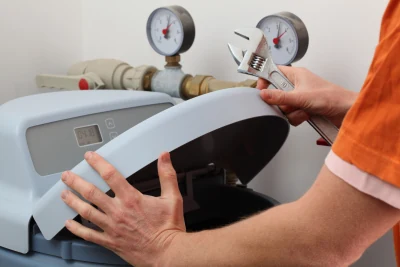
Our demand-metered ion-exchange softeners are calibrated for Hartselle’s 12–18 GPG water. They trap calcium and magnesium, cut soap use by 50%, and protect water heaters.
- 100% Calcium Scale Prevention
- Digital Demand-Initiated Regeneration
- Protects Tankless Heat Exchangers
Whole-Home Filtration & RO
Whole-home catalytic carbon eliminates chlorine odors, chloramines, and TTHMs at every tap. Pair it with 5-stage under-sink Reverse Osmosis to remove fluoride, lead, and microplastics.
- 99% Chlorine & Chemical Reduction
- 5-Stage Kitchen Reverse Osmosis (RO)
- Iron & Silt Filters for Rural Wells
Water Heater Repair & Descaling
Hearing popping sounds or getting lukewarm water? We perform high-pressure descaling flushes, upgrade burned-out elements to low-watt-density incoloy units, and install new anode rods.
- Tank & Tankless Acid Descaling Flushes
- Heavy-Duty Incoloy Element Upgrades
- Sacrificial & Powered Titanium Anodes
Understanding the Hartselle Utility Board Water Quality Report
Each year, the Hartselle Utility Board publishes a Consumer Confidence Report (CCR) under the Safe Drinking Water Act and ADEM rules. It confirms that Hartselle water meets federal safety limits for microbes and regulated toxins.
However, homeowners should understand an essential distinction: legal compliance does not equal optimal water for household plumbing.
“Municipal utilities deliver biologically safe water at scale. They are not required to remove calcium and magnesium hardness because hard water is not an acute toxin. Preventing scale damage, appliance burnout, and chlorine irritation remains the homeowner’s responsibility.”
— Hartselle Master Plumbing Advisory Team
Frequently Asked Questions About Hartselle Water
Direct answers regarding tap water safety, testing, hardness levels, and treatment solutions in Morgan County.